The other night I couldn't sleep. Over the Christmas break, a friend had mentioned a competition from a while back to redesign Monopoly. The idea stuck in my head. What an interesting challenge: “How do you redesign Monopoly as simply as possible while keeping the core of the game intact?”
I tossed and turned over the question for hours. My, admittedly poor, repayment for insomnia was several ideas that might actually work. I thought I'd share them.
Before going into detail, I should clarify that I actually like Monopoly a lot. I know, that puts me in a minority. Most people find it either too long or too luck-based or both. I admit that those issues are there, but I love it anyway. The history behind the game is fascinating, both the story of its creation and the uniqueness of its design for the time. The core system of buying property, trading it and profiting from it is really fun and exciting. I have a ton of fond memories of hardball negotiations and impossible comebacks, not to mention the arguments over house rules that preceded every game with my friends. Those discussions helped kindle my interest in game design. I at least have to respect Monopoly for that. It's just barely enough to compensate for the tedium that suffuses most of the game.
Before redesigning Monopoly it's important to understand what works about the game and what doesn't. As mentioned, what works for me most is the wheeling and dealing. I like having to valuate properties, sort out trades and hope I get the better end of the deal. I especially love making money off my opponents when they land on my spaces. (I promise, I'm not really as soulless as that sounds.) And I like the tension that the dice add to those moments.
What I hate about Monopoly is being in last place and feeling like I have no way to compete; or conversely, having a commanding lead and knowing that I need to go through the motions for another hour before the deed is done. I hate having almost no control over the outcome of my turn. Most of all, I hate that trading properties, my favourite part of the game, happens in a quick flash and then is done forever. To that end, my modifications need to change the end-game condition to make the game shorter and more fair; give players more control over the outcome of turns while maintaining a degree of uncertainty; and give players reasons to trade properties all throughout the game, not just in the middle of it.
With that, I offer Bertonopoly: my set of rule modifications that attempt to improve on and emphasize the core of what makes Monopoly interesting in the first place. I limited myself to use only the components that come in the box (the one I grew up with anyway – I'm not sure if they've added weird stuff in the intervening years). If I don't say a rule has changed, assume that it hasn't.
Bertonopoly
Showing posts with label Game Design. Show all posts
Showing posts with label Game Design. Show all posts
Monday, 11 January 2016

Friday, 20 November 2015
The Beautiful Game
Back from hiatus with my #3 game on my arbitrary list.
#3 - Go
There are a lot of different reasons I might love a game. Maybe it's strategically engaging, or leads to fun interpersonal dynamics, or provides good stories, or it's simply hilarious. The games that I've written about here all exhibit those traits to one degree or another. Go exhibits them too. But that's not why I love it.
I love Go because it's beautiful. Not beautiful in the way that many games have painted boards or sculpted miniatures. Beautiful in the way a poem or a piece of music is beautiful. Go, for some reason, resonates with me.
#3 - Go
There are a lot of different reasons I might love a game. Maybe it's strategically engaging, or leads to fun interpersonal dynamics, or provides good stories, or it's simply hilarious. The games that I've written about here all exhibit those traits to one degree or another. Go exhibits them too. But that's not why I love it.
I love Go because it's beautiful. Not beautiful in the way that many games have painted boards or sculpted miniatures. Beautiful in the way a poem or a piece of music is beautiful. Go, for some reason, resonates with me.
Wednesday, 7 October 2015
Soy You Think You Can Plant?
Way back when I started this blog, I was making a list of my favourite games. Weirdly, that list is still the same two years later, so I'm going to finish that series. Starting today, with :
#4 - Bohnanza
Negotiation is a remarkably difficult game mechanic to get right. Co-operative and team-based games bypass it completely, since the rules force players to work together rather than fluidly bringing them into and out of alliances through play. That leaves competitive games, but since most have a single winner, opponents have little incentive to help each other. A good trade implies value for both sides, which makes trading a bad idea in situations where competitors want to win at all costs. Conversely, if a deal is truly equitable between participants, then nothing has changed and it may as well not have happened. Game designers seeking to encourage negotiation have to offer opportunities for deals where players benefit unequally but each individual thinks they themselves came out on top. It's not easy.
Bohnanza may as well be a blueprint for how to do it right. The game consists of a deck of cards, each representing a bean. There are about a dozen different kinds, from the commonplace Wax Bean to the unfortunate Stink Bean. Players are farmers, trying to plant, grow and sell their beans as efficiently as possible to make the more money than their rivals. The ridiculous premise hides the depth of the system underneath. Every element of Uwe Rosenberg's design pushes players toward arguing over exchange rates, undercutting prices and dangling future profits in front of each other. You've never heard of such cutthroat bean farmers.
Friday, 25 October 2013
Taking Power
#5 - Tammany Hall
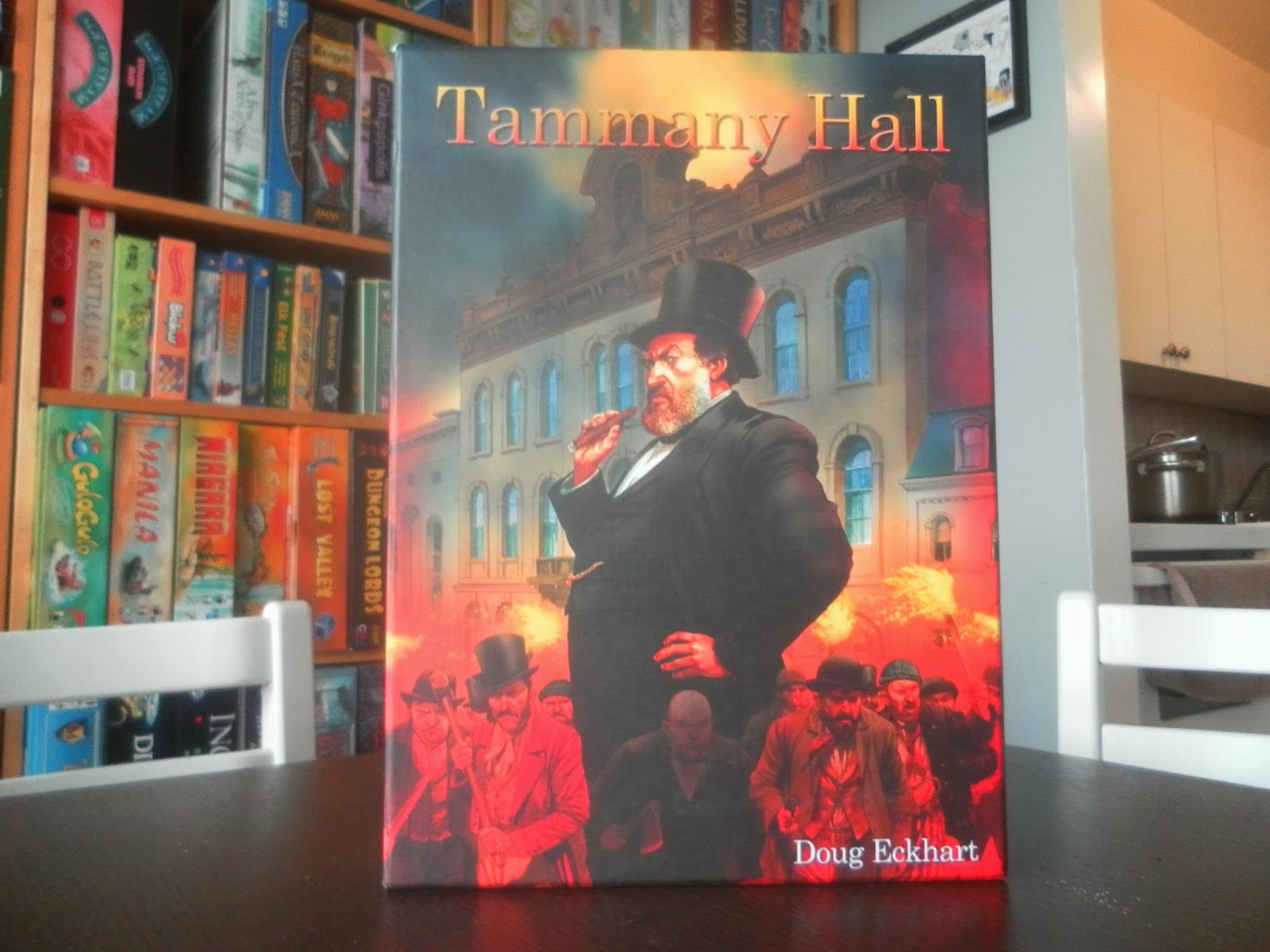 One of the great things about games is their power to tell stories. Whether it's knights fighting dragons or German bureaucrats buying merchant houses, games can engross you in narratives that you create with your friends. My favourite game stories are those with troubling historical
settings: those periods when reprehensible actions led to positive
effects or good intentions created disasters. Unfortunately, most games
get in the way of these narratives by having contrivances that may make
for fun experiences but break the suspension of disbelief. Why are the
Catan's harbours built before anybody's settled the island? Why are the
richest real estate barons in New Jersey forced to stay at each other's
hotels? All too often, game designers focus on the puzzle-like and
competitive aspects of games, ignoring their storytelling potential.
It's possible to design a game that's interesting because of both the
challenge it poses and the stories it tells. It's hard, but when it
succeeds, it's amazing. Not attempting to create that connection between
the game, the players and a story is a missed opportunity.
One of the great things about games is their power to tell stories. Whether it's knights fighting dragons or German bureaucrats buying merchant houses, games can engross you in narratives that you create with your friends. My favourite game stories are those with troubling historical
settings: those periods when reprehensible actions led to positive
effects or good intentions created disasters. Unfortunately, most games
get in the way of these narratives by having contrivances that may make
for fun experiences but break the suspension of disbelief. Why are the
Catan's harbours built before anybody's settled the island? Why are the
richest real estate barons in New Jersey forced to stay at each other's
hotels? All too often, game designers focus on the puzzle-like and
competitive aspects of games, ignoring their storytelling potential.
It's possible to design a game that's interesting because of both the
challenge it poses and the stories it tells. It's hard, but when it
succeeds, it's amazing. Not attempting to create that connection between
the game, the players and a story is a missed opportunity.
No game capitalizes on that opportunity as well as Tammany Hall. Nothing feels shoehorned in; every aspect of the game flows naturally and logically from its setting and characters without sacrificing any strategic depth. The fact that the setting is 19th century New York City and the characters are corrupt politicians who stop at nothing to gain power makes me wonder whether Doug Eckhart designed the game specifically for me.
One of the great things about games is their power to tell stories. Whether it's knights fighting dragons or German bureaucrats buying merchant houses, games can engross you in narratives that you create with your friends. My favourite game stories are those with troubling historical
settings: those periods when reprehensible actions led to positive
effects or good intentions created disasters. Unfortunately, most games
get in the way of these narratives by having contrivances that may make
for fun experiences but break the suspension of disbelief. Why are the
Catan's harbours built before anybody's settled the island? Why are the
richest real estate barons in New Jersey forced to stay at each other's
hotels? All too often, game designers focus on the puzzle-like and
competitive aspects of games, ignoring their storytelling potential.
It's possible to design a game that's interesting because of both the
challenge it poses and the stories it tells. It's hard, but when it
succeeds, it's amazing. Not attempting to create that connection between
the game, the players and a story is a missed opportunity. No game capitalizes on that opportunity as well as Tammany Hall. Nothing feels shoehorned in; every aspect of the game flows naturally and logically from its setting and characters without sacrificing any strategic depth. The fact that the setting is 19th century New York City and the characters are corrupt politicians who stop at nothing to gain power makes me wonder whether Doug Eckhart designed the game specifically for me.
Monday, 14 October 2013
That Game With All the Names and Stuff
#6 - Time's Up!
 A quick warning: I'm about to get very high-minded writing about a game that is essentially a souped-up version of charades. Before I do, I'd like to make one thing very clear: Time's Up! is fun. It's a ridiculous, ludicrous, hilarious good time. I cannot recommend enough to anybody who likes doing fun things. Go, grab your friends and play it right now. You will not regret it, because the game is awesome. Got that? Good.
Simply being fun would not be enough for Time's Up! to make it onto this list. I've played a lot of games with that same pure, intense, fun feeling that
Time's Up! overflows with. But this one has something more: it's not just fun, it's interesting. “Fun” makes me enjoy a game while I'm playing it; “interesting” keeps me enjoying it even after the game is over. And Time's Up! is as exceptionally interesting as it is fun. It takes one of the most classic gaming paradigms – the guessing game – and turns it into a vehicle for exploring how discourse communities are created.
 A quick warning: I'm about to get very high-minded writing about a game that is essentially a souped-up version of charades. Before I do, I'd like to make one thing very clear: Time's Up! is fun. It's a ridiculous, ludicrous, hilarious good time. I cannot recommend enough to anybody who likes doing fun things. Go, grab your friends and play it right now. You will not regret it, because the game is awesome. Got that? Good.
 Simply being fun would not be enough for Time's Up! to make it onto this list. I've played a lot of games with that same pure, intense, fun feeling that
Time's Up! overflows with. But this one has something more: it's not just fun, it's interesting. “Fun” makes me enjoy a game while I'm playing it; “interesting” keeps me enjoying it even after the game is over. And Time's Up! is as exceptionally interesting as it is fun. It takes one of the most classic gaming paradigms – the guessing game – and turns it into a vehicle for exploring how discourse communities are created.
Saturday, 28 September 2013
Spotters Ready?
I don't think I've yet mentioned that I have a twitter account. Well I do! @ThomasMBerton. I don't post very much right now, but I'll try to do more. Now the next in my list of the Top Ten Games That Make Me Love Games:
#7 - Hanabi
 Hanabi is without a doubt my favourite co-operative game. Co-op games, where the players work together to accomplish a shared objective rather than competing, have become increasingly popular over the past few years. I think co-op games as fitting into three main groups: “Alpha Player” games, like Pandemic, where the player most familiar with the game can advise the others on what to do so that the team can achieve victory; time constraint games, like Space Alert, which eliminates Alpha Players because the game moves too quickly for coherent communication in the heat of the moment; and traitor games, like Battlestar Galactica, where one or more players are secretly working against the rest, making it difficult to know who to trust. Each type is fun in its own right, but Hanabi is in a category all of its own: its not so much a game as it is a trust fall disguised as one. That allows it to better evoke the essence of co-operation than any game I can possibly imagine.
#7 - Hanabi
 Hanabi is without a doubt my favourite co-operative game. Co-op games, where the players work together to accomplish a shared objective rather than competing, have become increasingly popular over the past few years. I think co-op games as fitting into three main groups: “Alpha Player” games, like Pandemic, where the player most familiar with the game can advise the others on what to do so that the team can achieve victory; time constraint games, like Space Alert, which eliminates Alpha Players because the game moves too quickly for coherent communication in the heat of the moment; and traitor games, like Battlestar Galactica, where one or more players are secretly working against the rest, making it difficult to know who to trust. Each type is fun in its own right, but Hanabi is in a category all of its own: its not so much a game as it is a trust fall disguised as one. That allows it to better evoke the essence of co-operation than any game I can possibly imagine.
 Monday, 23 September 2013
To Be or Not to Be
Sorry this one's so late! Guess I underestimated how much of my time school would take up. To stop this from happening again, I'm going to reduce my posting schedule to twice a week, Mondays and Fridays. That should be easier for me to stay on top of. Anyway, here's the article.
#8 - Battle Line:
 Commitments are tough. We're all scared of them, in one way or another, whether the commitment is to a partner, a job, a pet or a wedding invitation. It's always risky to put your whole weight behind a decision. Committing too early or too strongly can be dangerous: you might break up or lose your job or end up living with a tiger rather than the tabby you thought you were getting. Games are especially good at reminding us of the dangers of commitment. Do I start down this strategic path or leave my options open? Do I make my big play now or stall to see what my opponent does? Decisions about commitment are some of most interesting ones to force on players because of how they can lock you into or out of a strategy.
Battle Line, my favourite game by the prolific Reiner Knizia, is a great example of how games can play with
issues of commitment. Its setting works particularly well for this: both players are generals, sending out troops, trying to win several battles that take place, predictably, in a line. This immediately makes
commitment a focal point for the game. We're all familiar with images of generals huddling over maps, deciding where, when and how they will deploy their troops. A wrong move – too many soldiers this way, a flank left open at the wrong time – can cost lives, battles and wars.
#8 - Battle Line:
Battle Line, my favourite game by the prolific Reiner Knizia, is a great example of how games can play with
Tuesday, 10 September 2013
Melting, Sliding Dice
Before I get to number #9 on my list of Games That Make Me Love Games, I'd like to clarify something. My article on Jaipur last week was slightly hyperbolic. Obviously, there are other light strategy games that, like Jaipur, are wonderful for casual social situations. My argument was meant to be more "I love this game and here's something interesting about it" than "This game is the best at what it does and that's why I love it." A fine distinction, perhaps, but I think an important one. This is not meant to be a definitive list of the best games ever, but rather an introduction to my tastes and design interests. That's especially worth noting now, because today's article is very design-focused. If you like it, I suggest checking out this one by Jon Shafer, which was a big inspiration to me.
#9 - Alien Frontiers
At the core of every strategy game is a tension between control and chaos. By definition, a strategy game is one where player action directs outcomes. The big moments in the game, those that end up deciding the winner and losers, need to be player-controlled. If victory relies on simple luck, your choices feel hollow and any sense of strategy disappears. However, games where all outcomes are predictable preclude the possibility of comebacks, upsets and surprises. My favourite games are those that show an understanding of this tension and know when to give players control and when to take it away. They let me create a vague outline of a strategy which gets filled in as the game progresses and shifts focus when necessary.

I love Alien Frontiers because of how it puts this tension front and centre. Every aspect of the design encourages – or forces – players to change their strategies as they compete to colonize a newly discovered planet. On any given turn, there may be an optimal move, but it's impossible to predict what next turn's optimal move will be, meaning that players are constantly thrown out of any ruts they might fall into. The game's insistence that every turn should require me to re-evaluate my goals – as well as those of my opponents – keeps it tense and exciting every time I play.
At the core of every strategy game is a tension between control and chaos. By definition, a strategy game is one where player action directs outcomes. The big moments in the game, those that end up deciding the winner and losers, need to be player-controlled. If victory relies on simple luck, your choices feel hollow and any sense of strategy disappears. However, games where all outcomes are predictable preclude the possibility of comebacks, upsets and surprises. My favourite games are those that show an understanding of this tension and know when to give players control and when to take it away. They let me create a vague outline of a strategy which gets filled in as the game progresses and shifts focus when necessary.

I love Alien Frontiers because of how it puts this tension front and centre. Every aspect of the design encourages – or forces – players to change their strategies as they compete to colonize a newly discovered planet. On any given turn, there may be an optimal move, but it's impossible to predict what next turn's optimal move will be, meaning that players are constantly thrown out of any ruts they might fall into. The game's insistence that every turn should require me to re-evaluate my goals – as well as those of my opponents – keeps it tense and exciting every time I play.
Thursday, 5 September 2013
Making Friends with Commerce
Here's the first in my list of the Top Ten Games That Make Me Love Games. I'll be updating each of these articles with links to the later ones in the future, so if you're reading this in the future, just click through the links at the bottom of each page. For us losers in the present, we just get one article for now.
#10 - Jaipur
 Jaipur is not the deepest strategy game ever. You're not going to see Jaipur tournaments, or pages-long threads on BoardGameGeek.com discussing its tactical nuances. I don't care. Not every game needs to be Go or Twilight Struggle. Great games – and great game designers – set out to accomplish something specific and hone in on that goal with everything they've got. As long as the goal is admirable and well accomplished, the game should be praised. I'll never stop praising Jaipur, because it fills an extremely useful role for me and all gamers: it's a ready-made social facilitator.
#10 - Jaipur
Subscribe to:
Comments (Atom)